
Monday – Friday: 9 AM – 5 PM (Evenings and Weekends by Appointments)


We Are Multilingual!

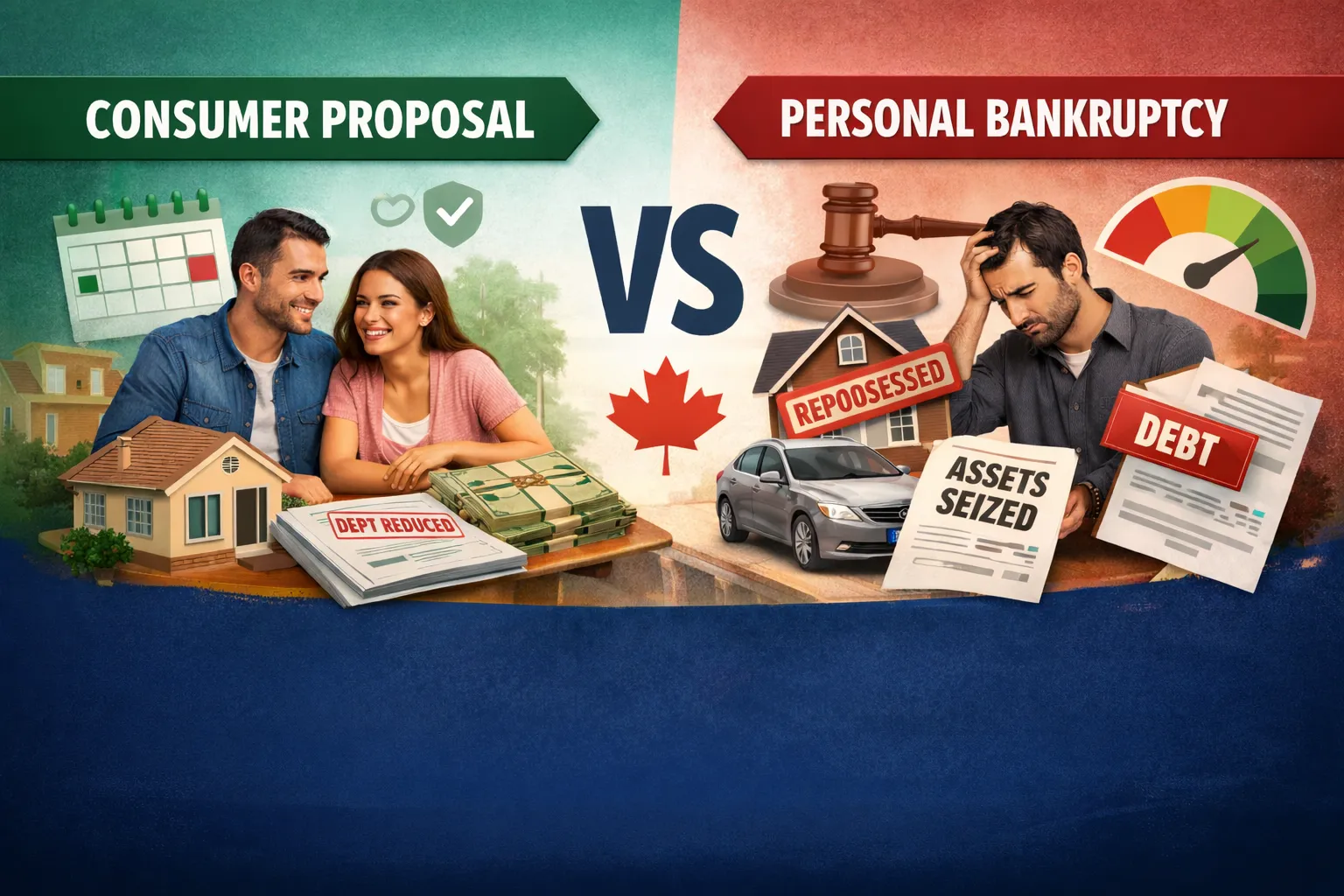
When debt collectors call daily and credit card balances spiral, Canadians often face a tough decision: consumer proposal vs personal bankruptcy. These two options under Canada’s Bankruptcy and Insolvency Act both stop creditor harassment instantly, but one might save you thousands while the other protects your home. With living costs soaring and interest rates biting, more people search consumer proposal vs bankruptcy Canada to find relief that fits their life. This article breaks it down simply with numbers, examples, and real scenarios to show which choice puts more money back in your pocket.
Canadians search consumer proposal vs bankruptcy Canada because both solve overwhelming debt but in different ways – one preserves assets, the other minimizes payments. Here’s the quick side-by-side:
Personal bankruptcy starts when a bankruptcy trustee in toronto files your case, triggering an automatic stay on collections, wage garnishments, and lawsuits. You surrender non-exempt assets (handled by the trustee) and make payments based on income surplus for 9 months (low income) or 21 months (higher earners). Duties include two credit counselling sessions and monthly income proof. At discharge, most unsecured debts vanish – no more payments.
Anyone owing $1,000+ who can’t pay bills when due qualifies. No upper debt limit exists, unlike proposals. Single filer earning $4,000/month with rent/mortgage might pay $200–$400 monthly based on family size and province.
Pros:
Cons:
Consumer proposal vs personal bankruptcy Canada highlights proposals as negotiated deals where a licensed insolvency trustee offers creditors partial repayment (often 20–40%) over five years max. Creditors vote – majority by dollar value approves it. No asset surrender needed if you stay current on secured debts like mortgages. Caps unsecured debt at $250,000 (mortgage separate), with fixed payments stopping interest accrual. Your consumer proposal binds all creditors once approved, even non-voters.
Eligibility caps unsecured debt at $250,000 (mortgage separate), perfect for middle-income households. Fixed payments ignore income fluctuations – $500/month stays $500 regardless of raises or job changes. Interest stops immediately, unlike consolidation loans compounding at 20%+.
Consumer proposal vs personal bankruptcy asset rules differ sharply. Proposals let you keep homes, cars, RRSPs, and tools if secured payments continue – no trustee seizure. Bankruptcy exemptions protect Ontario basics: $14,180 household goods, $11,300 tools, $7,117 car equity, $10,783 home equity (principal residence). Higher values risk sale, proceeds to creditors.
Business owners see proposals preserve income tools better, avoiding bankruptcy’s disruption to sole proprietorships. Homeowners with equity often pick proposals to dodge forced sales, saving far more than any payment difference.
Decision factors blend costs, assets, income. Low assets/high debt? Bankruptcy saves dollars. Equity/stable pay? Proposal protects wealth. Here’s how to choose via trustee questions:
Scenario 1: Renter, $80k cards, low income – Bankruptcy: $7k total vs proposal $32k. Bankruptcy wins.
Scenario 2: Homeowner $70k debt, $250k equity – Proposal $28k keeps home vs bankruptcy $50k+ equity loss. Proposal saves.
Scenario 3: Freelancer $100k ($40k taxes) – Proposal negotiates CRA, protects tools vs bankruptcy gear sale. Proposal edges.
Explore debt solutions in toronto matching your scenario.
Consumer proposal vs bankruptcy Canada boils to your numbers: dollars repaid, assets kept, stress endured, recovery speed. No universal winner—get personalized math from experts.