
Few collection tools cause more distress than wage garnishment. Unlike a collection call you can ignore or a letter you can set aside, garnishment hits the income you depend on directly. Money is taken from your paycheque before it reaches your bank account, every pay cycle, until the debt is paid or the order is stopped.
The good news is that wage garnishment in Canada operates within a clear legal framework, with strict limits on how much can be taken, who can take it, and when. More importantly, in most cases garnishment can be prevented before it starts, or halted once it has begun, provided action is taken quickly. This article walks through exactly how the process works, who has the legal authority to garnish your wages, the limits that apply, and the legitimate options available to stop it.
What Is Wage Garnishment?
Wage garnishment is a legal process that requires your employer to send a portion of your pay directly to a creditor instead of to you. It appears as a deduction line on your paycheque and continues, paycheque after paycheque, until the debt (plus interest and legal costs) is fully repaid or the order is lifted.
For most consumer debts, garnishment is a court-ordered process. A creditor cannot simply contact your employer and demand deductions. They must first sue you in civil court, win a judgment, and then apply separately for a garnishment order. There are important exceptions to this, particularly for tax debt and family support obligations, but the general rule is that wage garnishment requires legal authorization, not just creditor pressure.
Understanding this distinction is critical because it shapes both how the process unfolds and what you can do to stop it.
Who Can Actually Garnish Your Wages in Canada?
There are essentially three categories of parties with the legal ability to garnish wages in Canada, and they operate under very different rules.
Creditors with a court judgment. This is the standard route for ordinary consumer debts: credit cards, personal loans, lines of credit, unpaid utility bills, and similar obligations. The creditor (whether the original lender or a collection agency that has purchased the debt) must first sue you, win the lawsuit, and obtain a judgment. With the judgment in hand, they can then apply to the court for a garnishment order. The whole process typically takes months and includes multiple opportunities for the debtor to respond. It’s also worth knowing that in Ontario most consumer debts become statute-barred after two years of inactivity, meaning the creditor loses the right to sue. Our article on the statute of limitations for debt in Canada explains how this works and when it applies.
The Canada Revenue Agency (CRA). The CRA is the major exception. Under the Income Tax Act and other federal tax legislation, the CRA can issue a Requirement to Pay directly to your employer without going to court. This is the most powerful form of garnishment in Canada and one of the hardest to stop without formal action. There are options for managing CRA debt specifically, which we cover in detail in our guide on how to get rid of tax debt in Canada.
Family Responsibility Office or equivalent provincial agency. For unpaid child or spousal support, family law enforcement agencies can garnish wages directly without a separate civil judgment. In Ontario this is the Family Responsibility Office (FRO); other provinces have equivalent bodies. Support arrears are treated very differently from consumer debt and the enforcement powers are correspondingly stronger.
One point worth being clear on: collection agencies cannot garnish your wages directly. A collection agency that has not yet sued and won has no power to take money from your paycheque, regardless of what their letters or phone calls suggest. If a collector tells you that garnishment will begin next week, that’s not how the process works in Canada, and the threat itself may breach provincial collection rules.
How Much of Your Wages Can Be Garnished?
The amount that can be garnished depends on the province you live in, the type of debt, and the creditor involved. The rules vary significantly across Canada, and the differences matter, particularly if you’re trying to budget around an active garnishment.
For ordinary consumer debts pursued through the courts, the general picture across Canada is as follows. In Ontario, under the Wages Act, ordinary creditors can garnish up to 20% of your net wages (after statutory deductions like income tax, CPP, and EI). The remaining 80% is exempt. British Columbia, Alberta, Manitoba, and Saskatchewan each apply their own formulas, often combining a percentage with a minimum exempt amount that is protected regardless of income. Quebec uses a sliding scale based on family situation and income level, with significantly more generous exemptions than common-law provinces. The Atlantic provinces vary further still, with each setting its own limits and exemptions.
Two categories of debt fall outside these standard limits and are worth singling out:
- CRA garnishment can take up to 50% of employment income and up to 100% of contractor or self-employment income. The CRA is not bound by the provincial limits that apply to ordinary creditors.
- Family support garnishment can take up to 50% of net wages, sometimes more, depending on the arrears and the order.
If you have multiple garnishments running simultaneously, statutory limits on total deductions still apply, but the calculation gets complex, and the practical effect on a paycheque is severe. This is one of many situations where speaking to a professional becomes urgent rather than optional.
The Garnishment Process Step by Step
Knowing where you are in the process changes which options are available to you. The typical sequence for a consumer debt looks like this.
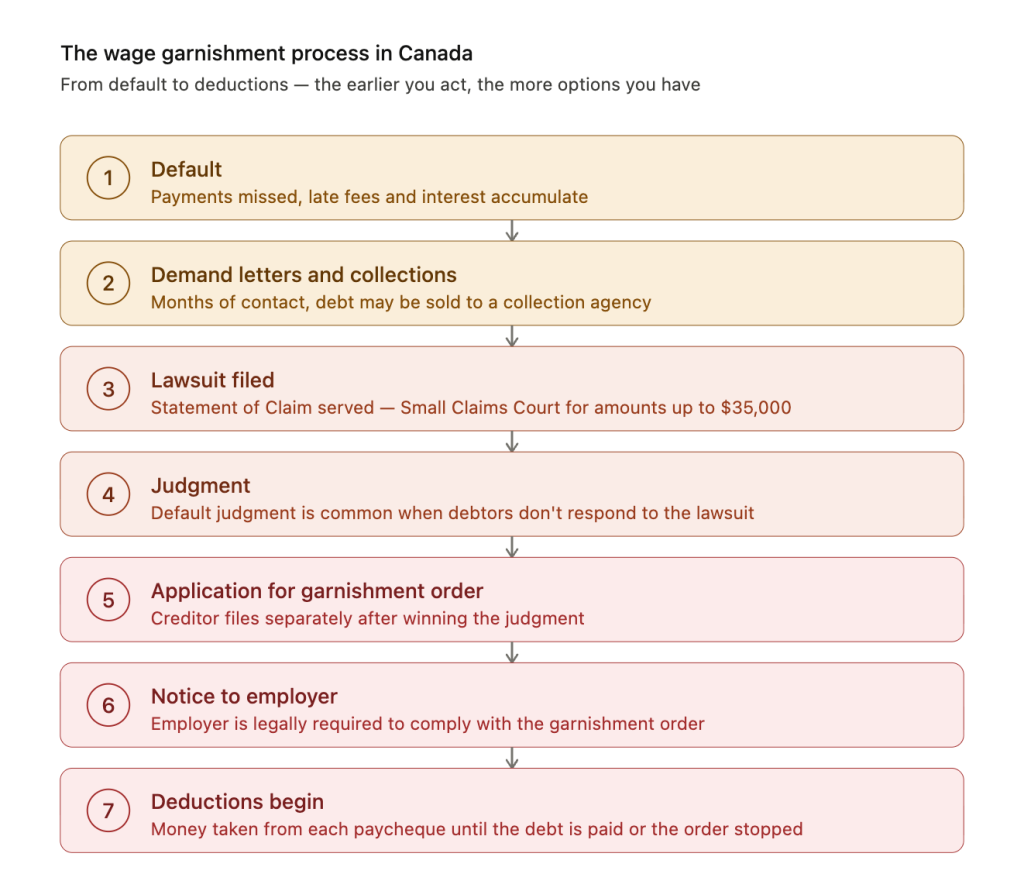
Stage 1: Default. Payments are missed. Late fees and interest accumulate. The creditor’s internal collections team begins contacting you.
Stage 2: Demand letters and collections activity. Months can pass at this stage, often with the debt eventually being assigned or sold to a third-party collection agency. No legal action has been taken yet.
Stage 3: Lawsuit filed. The creditor (or the agency that bought the debt) files a Statement of Claim in civil court and serves it on you. In Ontario, claims up to $35,000 are heard in Small Claims Court; larger amounts go to Superior Court.
Stage 4: Judgment. If you respond and contest the claim, the case proceeds. If you don’t respond, which is unfortunately common, as people often hope ignoring the lawsuit will make it go away, the creditor obtains a default judgment.
Stage 5: Application for garnishment order. With a judgment in hand, the creditor files a separate application for a garnishment order against your wages.
Stage 6: Notice to employer. The garnishment order is served on your employer, who is legally required to comply. Failure to do so exposes the employer to liability for the deducted amount.
Stage 7: Deductions begin. Within one or two pay cycles, deductions appear on your paycheque and continue until the debt is paid in full or the order is set aside.
The crucial point is this: the earlier you act, the more options you have. Acting at Stage 2 gives you many ways forward. Acting at Stage 7 narrows the options considerably, though, as the next section explains, even active garnishment can be stopped.
How to Stop Wage Garnishment
This is the question most readers come to this article for, so it deserves a clear, ranked answer. There are six legitimate options for stopping wage garnishment in Canada, and they vary significantly in speed, cost, and consequences.
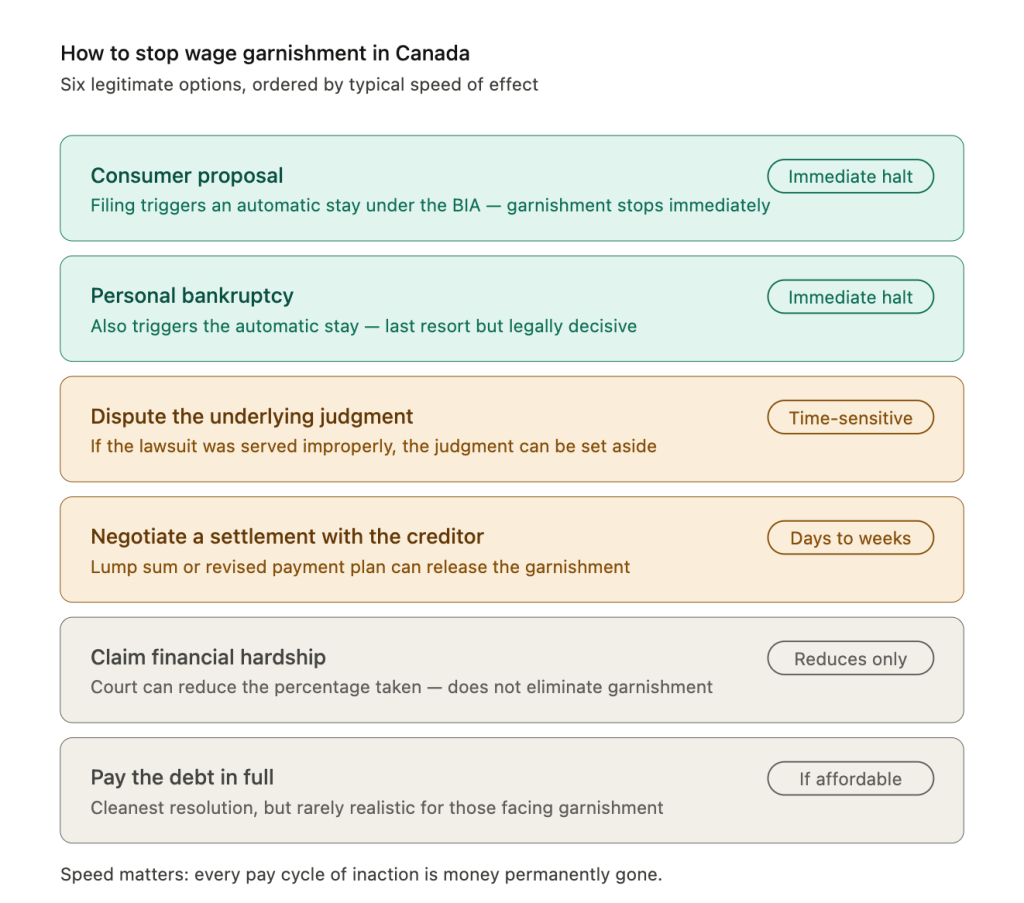
1. Pay the debt in full. The simplest option, but rarely realistic for someone facing garnishment. If it were affordable, it would have been paid before the lawsuit. Worth mentioning only because it is the cleanest resolution where possible.
2. Negotiate a settlement with the creditor. Particularly for older debts, creditors are often willing to accept a lump-sum settlement (sometimes 30 to 60% of the balance) or a structured payment plan to release the garnishment. This works best when you have access to funds, through family help, a tax refund, or a small loan, that you’re prepared to commit immediately.
3. Dispute the underlying judgment. If the original lawsuit was served improperly, or you have a valid defence to the debt that you weren’t given the chance to raise, the judgment itself can sometimes be set aside. This is time-sensitive and procedural; it usually requires legal advice quickly. Once the judgment falls, the garnishment order falls with it.
4. Claim financial hardship. Courts have discretion to vary garnishment terms where the standard percentage causes severe hardship, for example, if it leaves a single parent unable to afford rent. This doesn’t eliminate the garnishment but can reduce the amount taken each pay cycle.
5. File a Consumer Proposal. For most people facing garnishment, this is the strongest single option. A Consumer Proposal is a legally binding agreement administered by a Licensed Insolvency Trustee under the federal Bankruptcy and Insolvency Act. The moment a proposal is filed, an automatic stay of proceedings comes into effect under federal law, and this stay halts wage garnishment immediately, with very limited exceptions (CRA collections being the main one, though even these are usually paused). Beyond stopping the garnishment, a Consumer Proposal typically reduces the total debt owed and consolidates everything into a single affordable monthly payment for up to five years.
6. File for Personal Bankruptcy. Filing for personal bankruptcy also triggers the automatic stay under the BIA, immediately halting wage garnishment from ordinary creditors. Bankruptcy is more serious than a Consumer Proposal in its consequences and is generally a last resort, but for people in genuinely insurmountable financial situations, it is a legitimate, regulated, legal option that ends garnishment quickly.
The automatic stay under the BIA is, in practical terms, one of the most powerful tools available to a financially distressed Canadian. It’s the legal mechanism through which a Consumer Proposal or bankruptcy can produce immediate relief from active garnishment, relief that other options often cannot match for speed.
What If Your Wages Are Already Being Garnished?
If garnishment has already started, every pay cycle that passes is money permanently gone. The damage is ongoing, and it accumulates quickly.
A Consumer Proposal or bankruptcy filed while garnishment is active will stop future deductions almost immediately, but it will not recover money that has already been taken before the filing. That makes timing the most important variable. The difference between filing this week and filing next month can amount to hundreds or thousands of dollars in further deductions.
For anyone in this situation, the practical first step is a free initial consultation with a Licensed Insolvency Trustee. The consultation is confidential, costs nothing, and clarifies which of the options above is realistic for your circumstances and how quickly each can take effect.
Special Cases and Exceptions
A few situations don’t fit neatly into the standard rules and deserve specific attention.
CRA garnishment is governed by federal tax legislation and operates outside the standard provincial framework. The CRA can issue Requirements to Pay without a court judgment, and the limits that apply to ordinary creditors do not bind the CRA. Stopping CRA garnishment usually requires either a negotiated payment arrangement (the CRA is generally willing to negotiate with taxpayers acting in good faith) or a formal proposal or bankruptcy. This is one area where professional advice is particularly important, because the rules differ from those most people expect.
Self-employed individuals and contractors are not subject to wage garnishment in the traditional sense; there’s no employer to serve. However, creditors can pursue contract garnishment (intercepting payments owed to you by clients) and bank account seizure, both of which produce similar effects.
Multiple garnishments are subject to combined statutory limits, but the calculations are technical. If you have more than one creditor with a judgment, the total amount that can be deducted is capped, but each new order changes the picture, and a Consumer Proposal or bankruptcy generally produces a cleaner outcome than trying to manage several active garnishments simultaneously.
Frequently Asked Questions
Can a creditor garnish your wages without notice? No. The debtor is notified at multiple stages: when the lawsuit is filed, when judgment is sought, and when the garnishment order is issued. If you’ve never received any of these documents, the underlying judgment may have been obtained improperly and could potentially be set aside.
Can my employer fire me for being garnished? No. Under most provincial employment standards legislation, including Ontario’s, dismissing an employee because their wages are being garnished is illegal. Employers must process the garnishment but cannot use it as grounds for termination.
Does wage garnishment affect my credit score? Yes, though indirectly. The underlying court judgment is recorded on your credit report and remains there for several years. The garnishment itself isn’t a separate negative entry, but the judgment that authorises it certainly is. If you’re already past this point and dealing with the aftermath, our guide on how to rebuild credit after bankruptcy covers practical steps that apply equally to recovering from a judgment.
How long can wage garnishment last? Until the debt (including the original amount, accumulated interest, and legal costs) is paid in full, or until the order is stopped through one of the legal options above.
Can I have more than one garnishment at the same time? Yes. Multiple creditors with judgments can each obtain garnishment orders. Combined limits apply, but the practical effect on a paycheque can still be severe.
Can a collection agency garnish my wages? Not directly. A collection agency must first sue successfully and obtain a court judgment. Until that happens, threats of imminent garnishment are not legally accurate.
The Bottom Line
Wage garnishment is one of the most stressful financial situations a person can face, but it is not a dead end. Canadian law places clear limits on how much can be taken, requires creditors to follow a defined legal process, and provides genuine, well-established mechanisms for stopping garnishment, most powerfully, the automatic stay that comes with filing a Consumer Proposal or bankruptcy under the Bankruptcy and Insolvency Act.
The single biggest factor in resolving wage garnishment well is speed. Every pay cycle of inaction costs money that cannot be recovered. A free, confidential consultation with a Licensed Insolvency Trustee at Kunjar Sharma & Associates can quickly clarify which option will work fastest in your situation, what it costs, and what the next steps look like. With more than 40 years of experience and 6,000+ proposals filed across the GTA, our team has helped thousands of Canadians stop garnishment, regain control of their income, and rebuild from a stronger footing.
If your wages are being garnished, the most expensive thing you can do is wait.